Çalış is what happens when a shingle bar with a few fishermen's houses gets found by charter flights and then, mercifully, stops being found. Five kilometres north-west of Fethiye, it runs for roughly four: one seafront road, a row of low hotels behind it, flat farmland behind that, and a wide grey pebble beach looking west across the bay.
Nobody who knows the place would call it handsome.
What it has instead is a west-facing horizon, a promenade worth walking end to end, and a boat that crosses the water to Fethiye harbour rather than grinding round the flat by road. Those three things account for most of the people who keep coming back, some for twenty summers.
Five kilometres from Fethiye, and nothing like it
Administratively Çalış is a neighbourhood of Fethiye rather than a town of its own, which is not remotely how it feels. Fethiye works for a living — fish market, Tuesday bazaar, a harbour full of gulets, banks, a hospital. Çalış is a holiday strip: most of it exists because visitors turn up in summer, and a good share shutters in January.
Dolmuşes shuttle between the two continuously in season — fifteen minutes on a clear run, longer when August backs up on the coast road. From Dalaman Airport the distance is around 42 km and the drive an hour, give or take the lorries. The local transport picture is worth reading first.
No airport coach serves Çalış. The Havaş run east from Dalaman finishes at Fethiye otogar, four kilometres short of the front — a dolmuş or a taxi at the end of it, with your cases.
Treat Çalış as a base rather than as the point of the trip and you have read it correctly. Fethiye is a quarter of an hour off, Ölüdeniz around forty minutes, and the day boats leave from the harbour across the water.
Shingle, and no getting round it
Plainly: this is not a sand beach. Çalış is shingle and coarse pebble end to end, grey-brown, hot underfoot by eleven and unkind to bare feet at any hour. Beach shoes here are not an affectation — half the people on the front are wearing them.
Getting in is the other thing arrivals are rarely warned about. Shallow and stony, the shelf drops away so gradually that you wade an unexpected distance before it is deep enough to swim, over stones the whole way, some slick with weed.
Small children are safer here than almost anywhere on this coast. Adults who want a proper swim end up striking out to the raft, or going elsewhere.
Sunbeds cover the central stretch and thin towards both ends; north of the last hotels it gets close to empty even in August. Water quality is generally good, and the beach has carried Blue Flag status in recent seasons. Sea temperature reaches 27–28°C in August and stays swimmable, for most constitutions, into late October.
The wind arrives at two
On most summer afternoons a thermal breeze comes up the bay between one and three o'clock, and it changes the character of the place completely.
For windsurfers and kitesurfers this is the entire point of Çalış. Schools work from the beach, the fetch across the bay is long, and conditions are consistent enough to plan a trip around.
For everybody else it is the resort's real flaw. Parasols start flipping, the sea turns choppy, inflatables set off towards the islands with somebody's father swimming after them, and the glassy morning water is gone until tomorrow. Regulars swim early, eat late and write off the middle of the day.
A morning at Çalış and an afternoon at Çalış are two different beaches. Anyone who meets the second one first tends to leave with a poor opinion of the place.
What people actually come back for
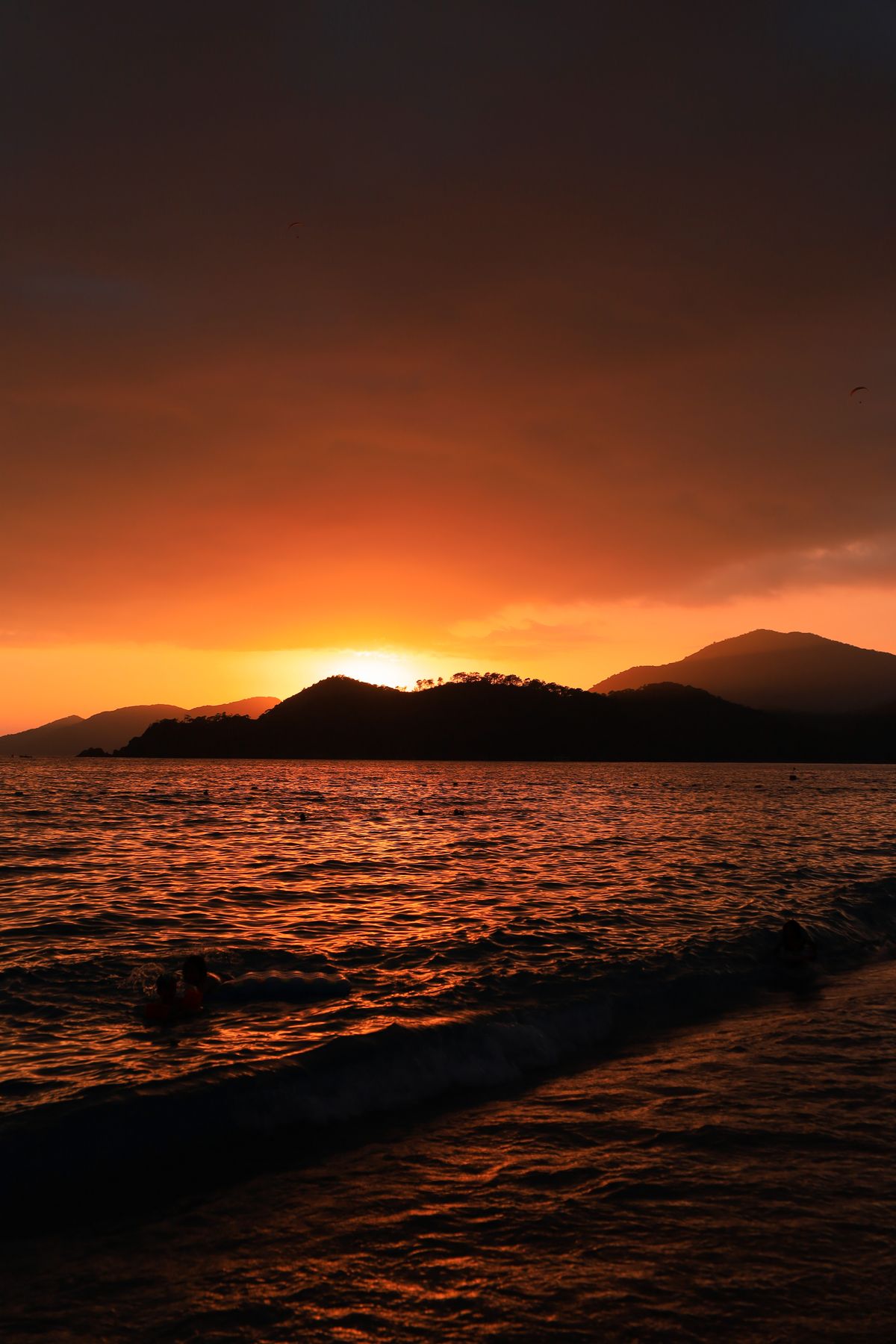
Çalış faces west, which on this coast is unusual and, in the last hour of daylight, decisive. Nearly every other resort around Fethiye looks at a headland or sits inside a closed bay. Here the horizon opens towards the islands off the harbour mouth — Şövalye Adası among them — and the sun drops straight into it.
Through July and August that happens between half past seven and eight. By late September it has slid forward to around seven, and the colour is usually better: cleaner air, fewer people, the ridge behind Fethiye holding light after the water has gone grey.
What turns it into a habit rather than a photograph is that the whole front is arranged for it. Bars swing their chairs round to face the water; people walk down from the apartments at the same hour every evening without discussing it. Very little else here is free, dependable and unbookable.
The promenade after six
A paved promenade runs the length of the beach, flat all the way, restaurants and bars on the landward side, pebbles on the other. End to end at an ambling pace takes about forty-five minutes, and long-stayers do precisely that most evenings — the closest thing this place has to a ritual.
Eating is a mixed proposition. Good Turkish kitchens operate along here — grilled fish, mezze, pide out of a proper oven, gözleme folded to order at a griddle. So does a long run of places doing full English breakfasts, roast dinners and karaoke, aimed at British visitors who have been coming for thirty years and want exactly that. Menu touts work the front in high season, and several buildings are visibly tired.
Tone is the compensation. Çalış at eleven at night is families finishing ice creams and couples on a third glass of wine; not Marmaris, and emphatically not the strip at Ölüdeniz. Dull, if you like — deliberately so, and why the same people book the same apartments year after year.
The crossing to Fethiye harbour
Roughly midway along the front there is a jetty, and from it a small boat crosses to Fethiye harbour in about twenty-five minutes, depending on swell and load.
Take it. Road traffic loops inland and grinds through the edge of town; the water route runs past Şövalye Adası with the whole ring of mountains behind Fethiye. Boats go roughly hourly in season, last return late evening, and stop entirely out of it — from about November to April the dolmuş is your only choice.
| How | Time | When it runs | Verdict |
|---|---|---|---|
| Water taxi | about 25 min | Roughly hourly, season only | The one to take |
| Dolmuş | about 15 min | Constantly, year-round | Cheapest, and fine |
| Taxi | 10–15 min | Any hour | Worth it late at night |
| On foot | about 1 hr 15 | — | Flat, coastal, good at dusk |
Coming back across in the dark, lights going on along the front, is the crossing people remember.
Behind the resort: reeds, storks, a river mouth
Immediately inland the land goes flat and agricultural — drainage channels, reed beds, greenhouses, cattle — and at the north end a river empties across the shingle into the bay. None of it appears in a brochure, and it is why a certain kind of visitor books here rather than somewhere prettier.
Birds use it heavily. White storks are the conspicuous ones, nesting on poles and pylons and stalking the fields all summer; grey herons and little egrets work the channels; kingfishers sit on the irrigation pipes. Migration pushes more through in spring and autumn. The productive window is the hour before dusk, north along the front and then inland onto the field tracks.
None of this is a managed reserve. No boardwalk, no hide, no interpretation boards — working farmland people have got into the habit of walking, so stay on the tracks and shut the gates. Bring repellent: standing water plus reed beds plus dusk gives the result you would predict, and the mosquitoes at the north end are bad from June onwards.
Who it suits, and who it doesn't
Short version:
- Families with small children — the shallow shelf, the flat promenade and the low-wattage evenings do the work.
- Long stays and shoulder season — apartments are plentiful and cheap; May, June and late September are the months to aim at.
- Anyone using Fethiye as a hub — market, harbour, otogar and hospital are a quarter of an hour off.
- Windsurfers — the afternoon breeze is a reason to come, not a reason to grumble.
- Not for sand — if the image in your head is fine sand and turquoise shallows, you want Ölüdeniz, crowds included.
- Not for nightlife — the front closes down softly and early, which is deliberate.
Çalış does three or four things unusually well and claims nothing beyond that. Local information comes from Fethiye municipality, the national tourist board keeps a regional overview at GoTürkiye, and background on the town and its bay sits on Wikipedia.