Fethiye is a town people live in — a dentist, a washing machine, a queue at the tax office. That is the most useful thing to know about it. Holidaymakers sit on top of all that rather than replacing it, which is why the place still works in October when the resorts round the bay have shuttered.
It runs a district of well over 150,000 people from one of the better natural harbours in the eastern Mediterranean, pine-covered mountain rising directly behind the last row of buildings. Ancient Telmessos stood on the same ground; so did Ottoman-era Makri, until the middle of the twentieth century removed it.
Arrivals expecting Ölüdeniz-with-shops are disappointed for roughly a day, then convert.
Why the town looks like this
Almost nothing standing in central Fethiye predates 1957. Over two nights in late April that year, severe earthquakes centred in the gulf brought down the town — the stacked houses on the slope, the harbour front, most of what a nineteenth-century traveller would have recognised. Rebuilding came fast, cheap and low, in the flat concrete idiom of the Turkish provinces in the 1960s.
Which explains the streetscape entirely. Wander the centre looking for an Ottoman old town, find wide-ish streets of three-storey blocks with shops underneath, and you are not missing it. It is gone.
Two other dates matter. In 1923 the Greek Orthodox population left under the population exchange, emptying the hill villages — the reason Kayaköy stands abandoned eight kilometres south. In 1934 Makri was renamed Fethiye, after Fethi Bey, an early Ottoman military aviator killed in a crash. A town that has changed both its buildings and its name inside living memory.
Fethiye rewards anyone who treats it as a town with ruins in it, rather than a ruin with a town built around it.
The harbour, the marina and the front
Everything orients towards the water. Şövalye Island sits across the mouth of the bay like a stopper, which is why the anchorage has been in continuous use for two and a half thousand years and why the water inside stays flat.
Working west along the front you pass, in order: fishing boats and day-trip gulets tied three deep, the ferry and water-taxi jetty, then Ece Marina, the yacht harbour proper, several hundred berths of hardware whose owners are somewhere else. Beyond it the road climbs into Karagözler, the residential slope holding most of the town's small hotels.
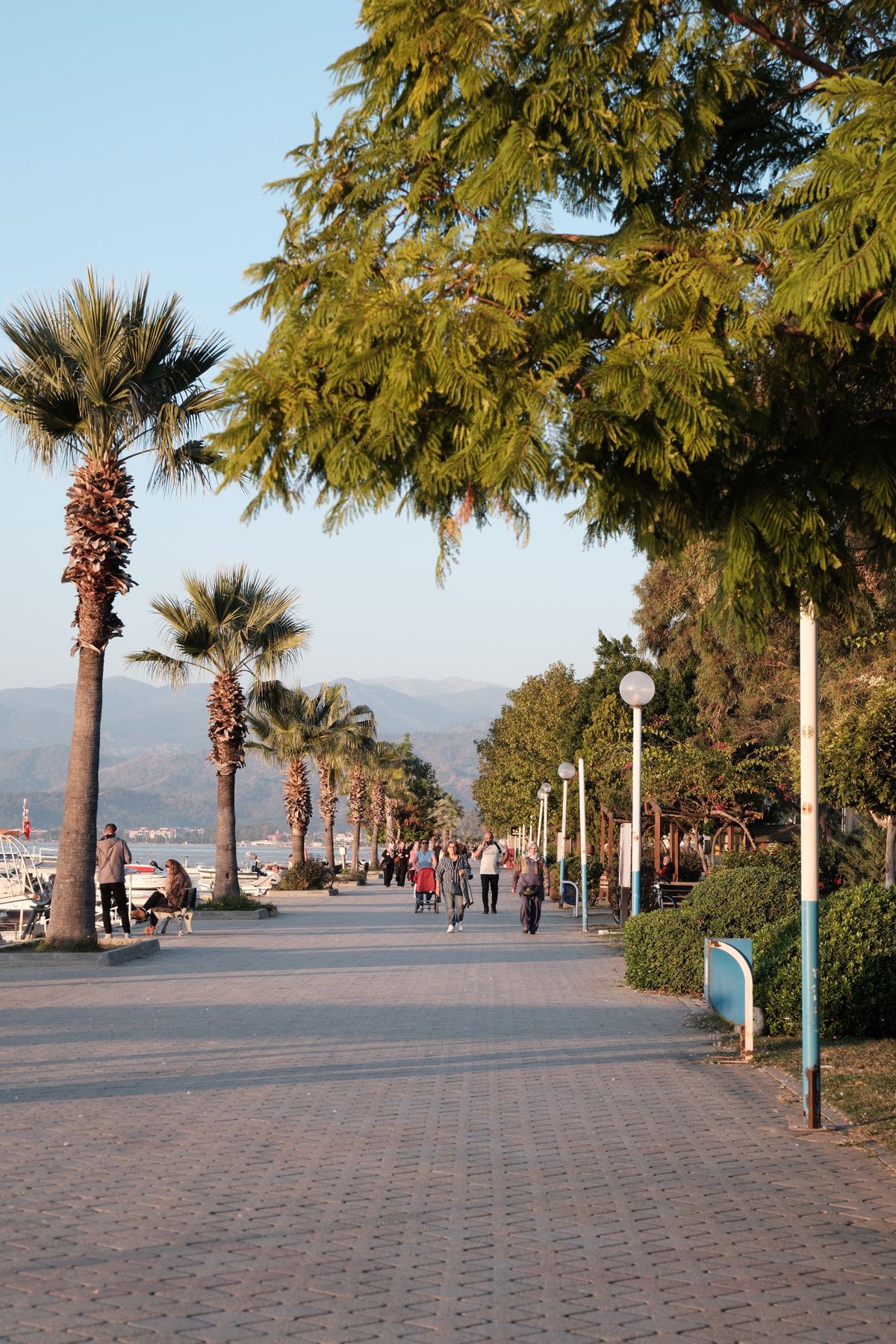
The promenade is the town's evening room. Families walk it from about six until late, ice creams in hand, and the pavement cafés fill with people who are not tourists. Sunset lands squarely across the bay from here — the one respect in which the geography is generous.
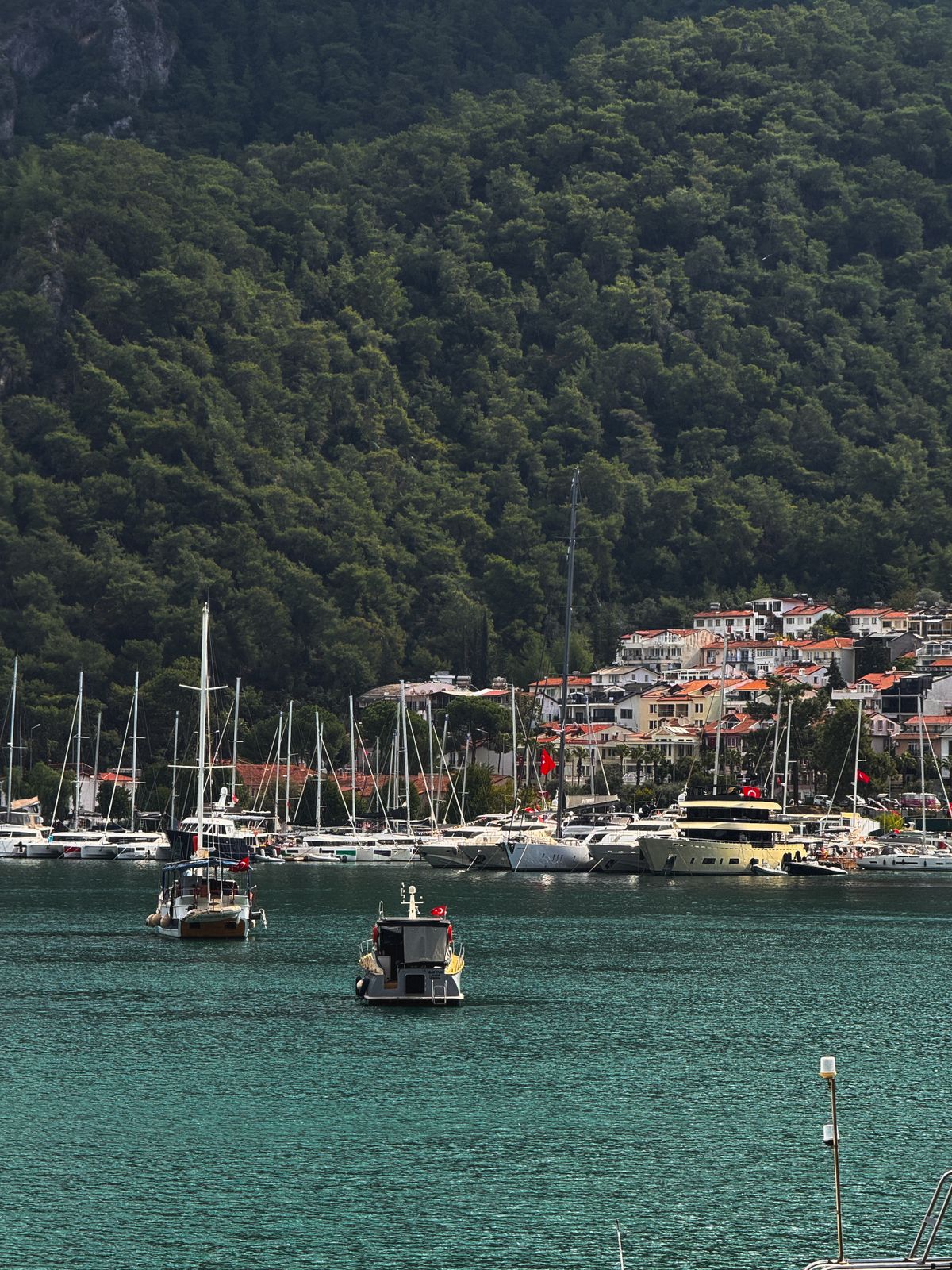
One caveat about that road in July and August: the day-boat touting is relentless and aimed at anyone walking slowly.
Paspatur, and what sits behind the front
One block inland, the grid gives up. Paspatur is the old bazaar quarter — narrow lanes, cobbles, bougainvillea, shopfronts pushed out into the walking space, awnings meeting overhead. Much of it is post-earthquake infill along older street lines: a rebuilt quarter that kept its shape, not a preserved one. Still the only part of the centre where you can get properly lost.
Trade runs to carpets, leather, jewellery, spices by the scoop and a great deal of counterfeit sportswear. Prices are negotiable and expected to be. Deeper in, shops thin out into bars, and by eleven a couple of lanes are loud in a way that matters if your window faces them.
Buy the fish, then find someone to cook it
Set in the middle of the old quarter is a square ring of fishmongers' stalls under a canopy, restaurants packed around it on all four sides. That arrangement is the point. Walk the stalls, look at what came in, agree a price by the kilo, then hand the bag to whichever restaurant you like the look of. They cook it for a per-head fee — the pişirme ücreti — usually bringing bread, salad and a first plate with it.
Common on the slabs: çupra (gilt-head bream), levrek (sea bass), barbun (red mullet), kalamar, prawns, and sardalya in the colder months. Much of the bream and bass on this coast comes from cages in the bays rather than off a hook; nobody hides it, nobody volunteers it either.
Settle two numbers before you sit down: the price per kilo, and exactly what the cooking fee covers. Meze arriving unrequested is not a gift, and that is where most complaints about the fish market start.
Done properly it is the best-value dinner in town. Done carelessly it costs more than the marina restaurants.
Tuesday takes over
The weekly market — Salı Pazarı — is the district's largest, running from early morning to mid-afternoon on the ground near the stadium. Growers come down from the hill villages: Kayaköy, Ovacık, Üzümlü, whose weavers still produce the striped cotton cloth that village is known for.
Two halves, not equally worth your time. Produce is excellent — tomatoes that taste of something, mountain honey, sacks of dried figs, olives from barrels, sheep's cheese cut to order, gözleme griddled while you wait. The clothing half is fake branded goods at volume; skip it unless that is what you came for.
Go before ten. By noon in high summer the aisles are airless and the good produce picked over.
A tomb above the roofs, a theatre beside the road
Look up from almost anywhere in the centre and there it is: a temple front cut straight into the limestone cliff behind the town — two Ionic columns, a pediment, a carved false door. That is the Tomb of Amyntas, mid-fourth century BC, Lycian, its inscription naming Amyntas son of Hermapias. Nothing else is known about him, which somehow improves the scale of the thing.
Entry is ticketed and cheap, up a long flight of steps from the streets below; smaller rock tombs pit the cliff on either side. At night the whole face is floodlit and visible from the harbour — arguably the better view, and free. Climb at seven in the evening rather than two in the afternoon: no shade on those steps, and August rock radiates heat back at you. Note too that the chamber inside is empty. You are paying for the façade and the drop over the bay. Background sits in the standard reference entry.
Down at sea level, metres from the harbour road, sits the theatre of Telmessos — Hellenistic in origin, remodelled by the Romans, seating perhaps five thousand, uncovered only in the 1990s when construction ran into it. No grand approach, no landscaping. Simply there, between traffic and buildings, which is a very Fethiye way to keep a Roman theatre.
Lycian sarcophagi stand about the town as well, several marooned mid-street. The museum, inland off Atatürk Caddesi, is small but holds the Letoon trilingual stele — Lycian, Greek and Aramaic — the object that did more than any other to make the Lycian language readable. Listings at muze.gov.tr.
| Place | Where | Allow |
|---|---|---|
| Harbour and promenade | the whole waterfront | 30–40 min on foot |
| Ece Marina | west end of the front | 20 min |
| Paspatur | one block behind the harbour road | an hour; longer after dark |
| Fish market | centre of Paspatur | a meal, not a visit |
| Telmessos theatre | beside the harbour road | 15 min |
| Tomb of Amyntas | cliff above town, signposted uphill | 1 hour with the steps |
| Tuesday market | near the stadium, east of centre | half a morning |
So where do you actually swim?
Not here. This is the honest weakness of Fethiye and the reason a good number of people book it and then wish they had not.
Town water is a working harbour: fuel, moorings, boat traffic, a seabed of chain. What municipal shore exists is thin, gritty and hemmed in by road. Anyone who came to this coast for sand should not plan on swimming from Fethiye itself.
Base yourself in Fethiye if you want a town — markets, fish, streets that exist for reasons unconnected with you. Base yourself in Çalış, five kilometres north, if you want to walk to the sea in the morning, or in Ölüdeniz over the ridge if the lagoon is why you came. Both are twenty minutes away, and the water taxi across the bay to Çalış is the nicest way to make that trip.
Otherwise: day boats leave the harbour each morning for the islands, dolmuş run constantly to Kayaköy and Ovacık, and the Lycian Way starts its 500-odd kilometres up the hill at Ovacık. None of that needs a car — see the register's transport entry.
May, June, late September and October show the town at its best: warm water, tolerable pavements, restaurants with free tables. July and August are hot, full and slow, and evening brings little relief. Municipal notices come from the Fethiye municipality; a regional overview sits at GoTürkiye.