Bags go into the room, and a different question starts. How do you reach the beach, the market, the gorge, the town along the bay?
Cheaply and easily, provided you stay within a couple of kilometres of the sea. Muğla's coastal strip runs one of the better informal transport systems in the Mediterranean. Go inland and it comes apart within a valley or two.
Below is the local picture — minibuses, the boat across Fethiye bay, two highways, and the point at which you give in and hire something. Getting from the terminal to your first bed is a separate matter.
How the dolmuş actually works
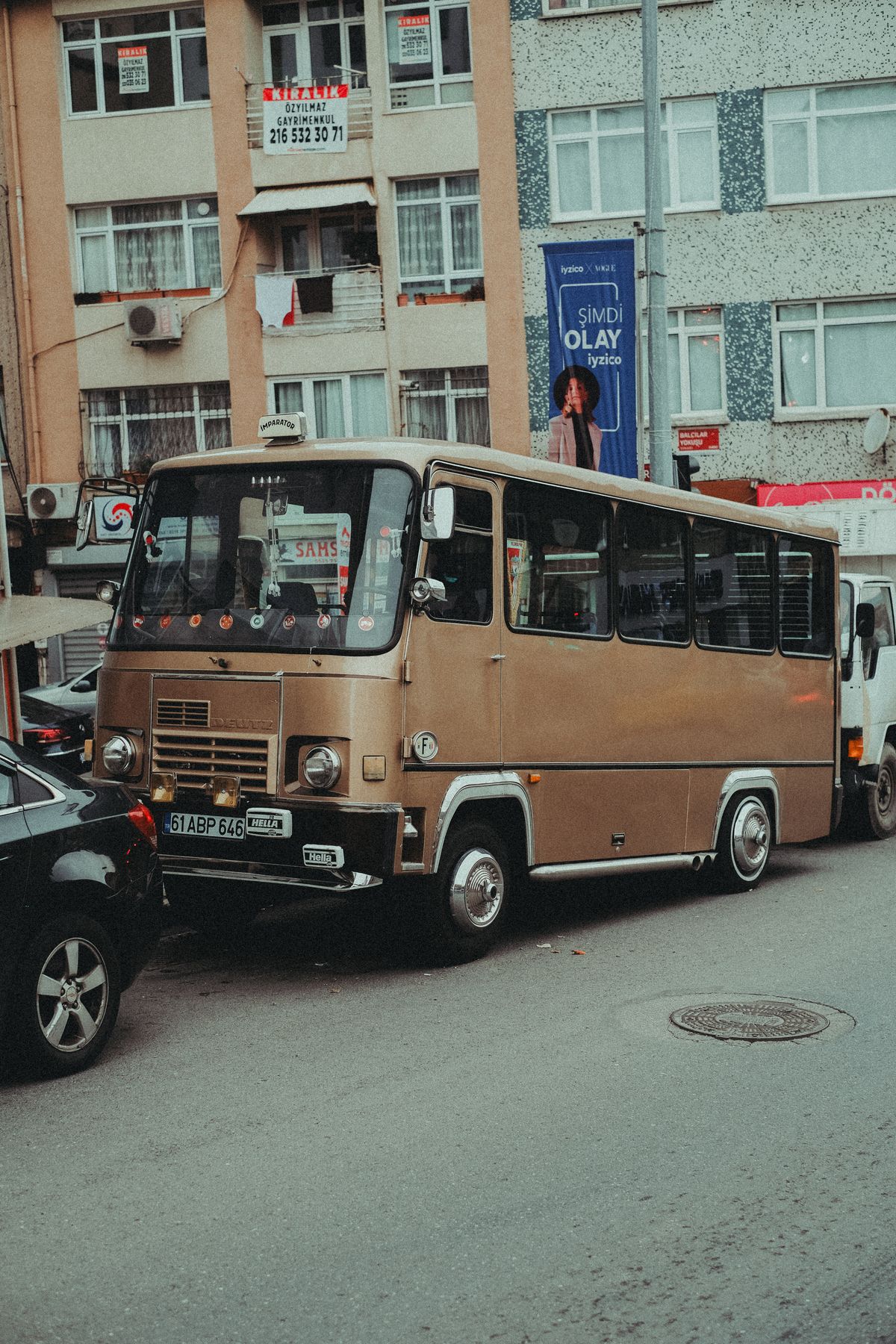
Everything rests on the dolmuş. That word means "filled", and it describes vehicle and business model at once: a minibus of fourteen to twenty seats, running a fixed route with its destination propped in the windscreen, leaving when enough people are aboard to justify the fuel.
No timetable exists in any form you could plan a day around. On the Fethiye–Ölüdeniz run in July one goes every ten or fifteen minutes and the question never arises. Same route in February: you wait while the driver finishes a cigarette and watches for a fourth passenger.
Three habits separate confident use from standing at a roadside looking hopeful.
- Flag it anywhere. Bus stops are a formality. Stand at the roadside at any point on the route, put your arm out flat, and if a seat is free the driver stops.
- Money travels forward. Pay the driver as you board if you sit near the front. From the back, hand your note to the passenger ahead and say şoföre. It travels up the bus hand to hand, and change comes back the same way, over shoulders, past strangers.
- Say when you want out. Müsait bir yerde, "somewhere convenient", is the standard phrase. A few minibuses have a buzzer; most do not.
Fares are cash and scale with distance. Shared minibuses are how much of the country moves, not only this coast — there is a sound general description of the system for anyone curious about the history.
Across the bay: the Çalış water taxi
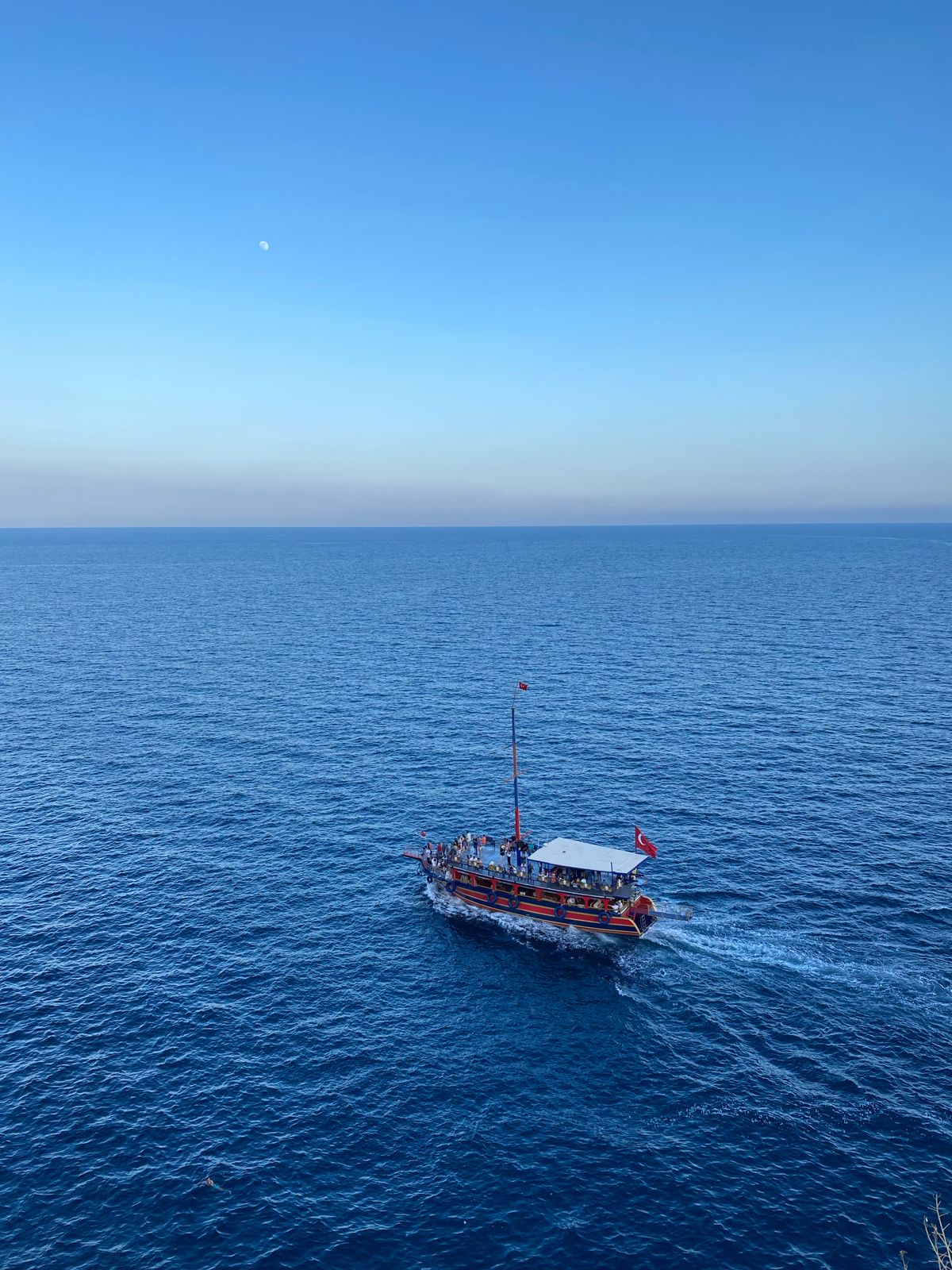
Çalış lies across a shallow bay from Fethiye, and the road between them swings inland around the wetland — five kilometres of tarmac to cover barely two by sea. Boats have been correcting that for decades.
Small wooden launches leave the jetty at the southern end of the Çalış promenade and reach the Fethiye harbourfront in twenty-five to thirty minutes, roughly hourly. Slower than the dolmuş, and better by a wide margin — particularly on the last crossing back, when the light goes flat orange behind the islands.
Two caveats. Service is seasonal — about May into October, nothing in midwinter. And when the afternoon wind gets up, the crossing turns bouncier than families with small children enjoy. Miss the final boat and you are buying a taxi the long way round. The resort has its own entry.
Two roads do most of the work
Nearly every journey in this province happens on one of two numbered roads.
The D400 is the coastal trunk route: Marmaris, Gökova, Köyceğiz, Ortaca, Dalaman, Göcek, Fethiye, then east out of the province. Surface is good. Speed is not — two lanes for long stretches, loaded lorries grinding the climbs, tractors emerging from citrus country onto blind bends. An hour on the map is seldom an hour in the car.
Between Göcek and Fethiye it dives through a tolled tunnel of about a kilometre that replaced a slow mountain pass. That old pass road is still open, and still holds the best view of Göcek bay.
D550 is the other one: the inland road leaving the coast near Köyceğiz and climbing north over the Sakar pass towards Muğla town, then on to Aydın and İzmir. Hairpins, gradient, lorries in second gear. Drivers bound for the Aegean cities use it; almost nobody on a beach holiday needs to.
| Journey | Distance | Usual mode | Time |
|---|---|---|---|
| Fethiye → Çalış | about 5 km | Dolmuş, or the boat | 15 min / 25–30 min |
| Fethiye → Ölüdeniz | about 14 km | Dolmuş, very frequent | 25–35 min |
| Fethiye → Kayaköy | about 9 km | Dolmuş, sparse off-season | 20–25 min |
| Fethiye → Saklıkent | about 45 km | Car, or summer dolmuş | about 1 hr |
| Marmaris → İçmeler | about 8 km | Dolmuş or sea taxi | 15–20 min |
| Fethiye → Marmaris | about 130 km | Coach on the D400 | 2 hr 30 – 3 hr |
Hire at the airport, or hire in town?
Both work. They suit different holidays.
Desks at Dalaman hand you a car the moment you land, which matters if your address is a villa up a track. You then pay for every day it sits there unused, and across a fortnight of mostly swimming that is a great many days.
Local firms in Fethiye, Marmaris, Dalyan and Ölüdeniz rent by the day, often deliver to your hotel, and undercut airport rates for a short mid-holiday hire. Fleets are smaller and cars older. Read the excess terms, photograph every scratch before driving off, and expect a charge for dropping the car anywhere but where you collected it.
Parking is the part nobody warns you about. From mid-July to the end of August the streets behind Fethiye harbour are a slow circling exercise, and the Marmaris seafront is worse. Paid car parks fill by mid-morning. If your accommodation has no space, settle that before hiring anything.
Scooters are cheap until they are not
Rental scooters stand outside shops on every resort street in Ölüdeniz, Hisarönü, İçmeler and Marmaris, generally available for a passport photocopy and few questions.
Things to know first. Anything above 50cc legally needs a motorcycle entitlement, and insurers examine that clause with enthusiasm after a claim. Helmets from rental shops are frequently the wrong size. Gravel collects on the bends, and the descent from Ovacık to Ölüdeniz is steep and shared with coaches.
A scooter is the right tool for a nine-kilometre run out to a village, and the wrong one for the D400, for luggage, or for the road down to the lagoon after dark.
Taxis in town
Yellow, metered, parked at ranks — taksi durağı — beside every harbour, otogar and main square. For a short hop with shopping, a late return from dinner, or the climb up to Hisarönü at one in the morning, they are the sensible answer. Ask for the meter at the start rather than negotiating at the end; over distance the numbers escalate steeply, and anything near intercity range belongs on a coach.
The otogar, and everything past the province
Every town of size has an otogar, and Fethiye's arrangement catches people out: the intercity coach station sits on the Ölüdeniz road, while the minibus garage for local dolmuş is a separate site nearer the centre. Turning up at the wrong one with a coach ticket is common enough that taxi drivers ask which you mean.
Coaches are run by named private companies rather than a state network, and standards are high. Seats are assigned. An attendant works the aisle with tea and lemon cologne. Alcohol is neither served nor permitted. Long runs break for twenty minutes roughly every three hours.
One detail goes unmentioned everywhere: the servis, a free company minibus shuttling ticket holders between otogar and town centre. Ask at the ticket desk. From Fethiye, İzmir is five to six hours and Istanbul an overnight commitment of twelve or more.
Where the network gives up
Now the honest part. Everything above describes a corridor — the coast road and the spurs hanging off it. This register's inland entries sit outside it, and the drop is abrupt.
Saklıkent gorge gets a summer dolmuş from Fethiye, a couple of runs a day, and effectively nothing off-season. Tlos is worse: the ruins stand above Yaka village with no scheduled service at all, and the nearest drop-off leaves you several kilometres and a hard climb short. Kayaköy fares better in high summer — but frequency thins to a handful of runs by October, and the last one back goes earlier than visitors expect. Ask the driver on the way out.
The arithmetic turns at about the third inland site. One is a dolmuş trip or a taxi fare. Three inside a week is two days of local car hire — less than the equivalent organised excursions, and you leave the gorge when you choose rather than when a coach does. Walkers have another option: the Kayaköy entry covers the footpath from Ölüdeniz.
Reduced to something usable: stay near the water and minibuses carry you anywhere for the price of a coffee; go inland and you need your own wheels for part of the week. Municipal route information is published by Muğla Metropolitan Municipality, with regional overviews at GoTürkiye and the culture ministry's Kültür Portalı.