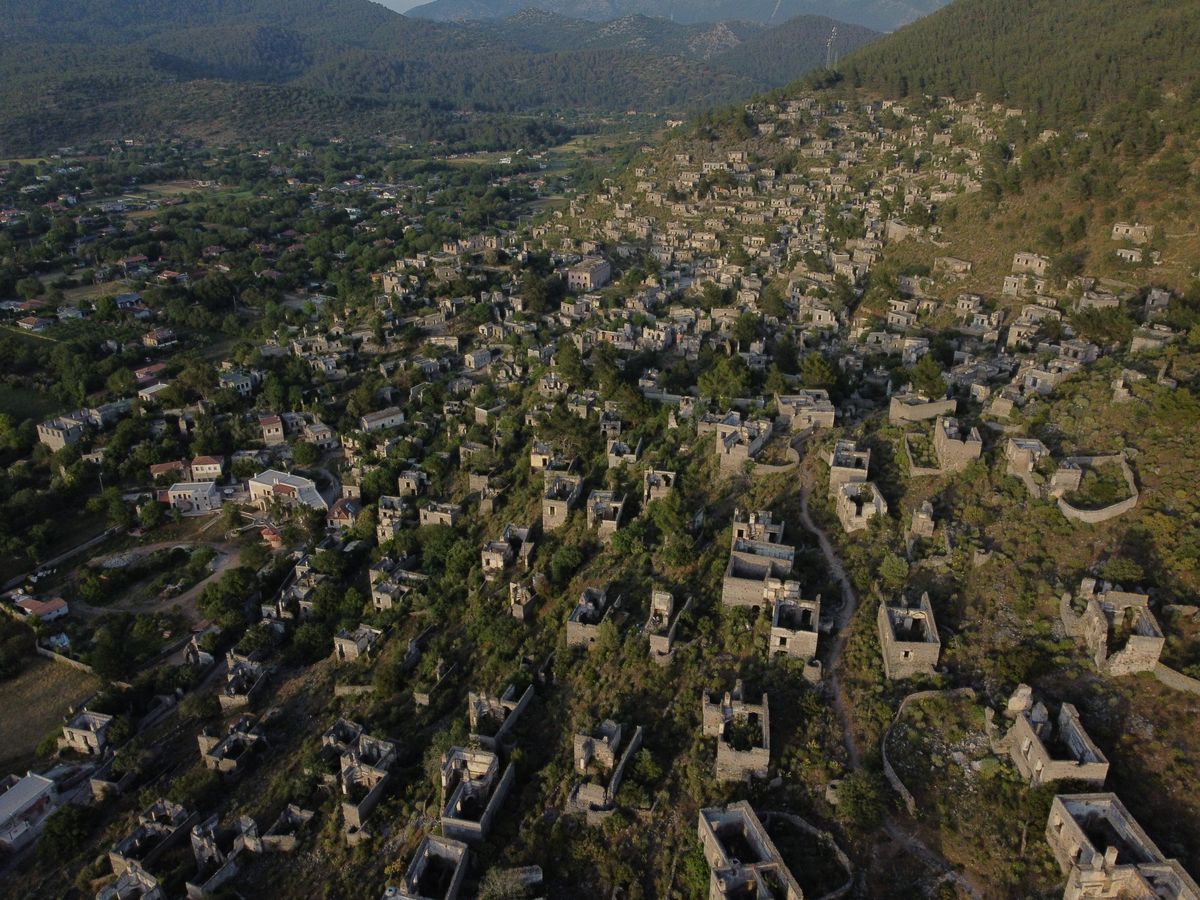
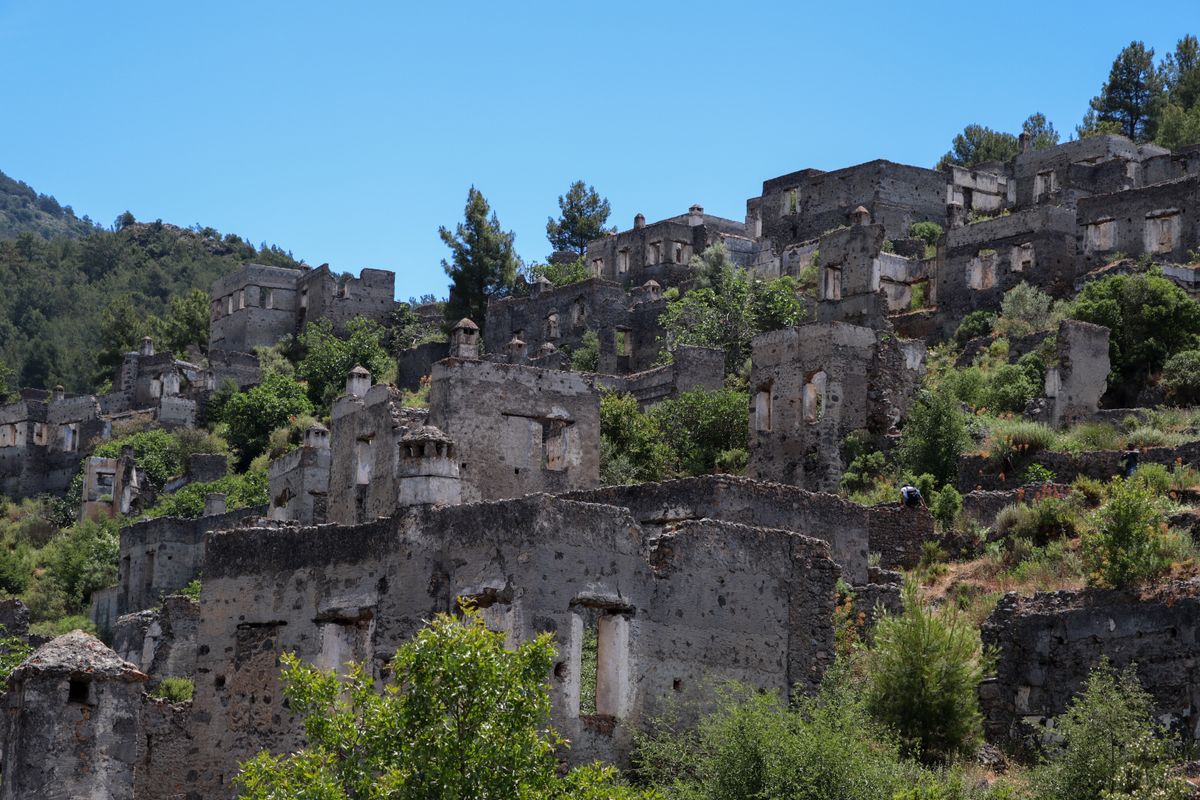
Eight kilometres south of Fethiye, on a slope that turns its back on the sea, several hundred stone houses stand with their roofs gone. Doorways, window openings, staircases and cistern mouths are all still in place. Nothing else is. Climb for twenty minutes and the scale starts to be uncomfortable — this was no hamlet that quietly faded out, but a working town of shops, schools and two large churches that emptied inside a single year.
Its Greek name was Levissi. Turkish maps call it Kayaköy, rock village, and a small inhabited Kayaköy of restaurants and a few pensions sits at the bottom of the hill. The ruin above it is a ticketed archaeological site.
Levissi, before 1923
Orthodox Christians had lived on this hillside for centuries — the settlement is usually traced to around the fourteenth century, built on or beside the ancient Lycian site of Karmylassos, whose rock-cut tombs are still visible in the cliffs nearby.
They were not farmers. Levissi lived by trade and craft — cobblers, ironworkers, masons, merchants who dealt with the Muslim Turkish villages on the plain rather than competing with them for land. That division explains the shape of the place. Houses stack tightly up a rock slope nobody wanted to plough, arranged with real care so that none blocks the light or the outlook of the one behind it. Gardens are almost absent. No spring exists here, which is why every house had its own cistern cut into the rock beneath it.
Population figures vary absurdly — two thousand in some accounts, six thousand or more in others, depending on which decade and whose census.
What the treaty actually did
The Convention Concerning the Exchange of Greek and Turkish Populations was signed at Lausanne on 30 January 1923, after the Greco-Turkish war of 1919–22. Compulsory, and sorted by religion rather than by language, birthplace or preference. Something like 1.2 million Orthodox Christians were moved out of Anatolia; roughly 400,000 Muslims out of Greece. Only the Greeks of Istanbul and the Muslims of Western Thrace were exempted.
Turkish-speaking Orthodox families were shipped to a country whose language they did not speak. Greek-speaking Muslims came the other way. The criterion was the church you were baptised in, applied without appeal.
Levissi's people went to Greece. Refugees from here and from Fethiye — Makri, in Greek — founded a settlement in Attica, east of Athens, and named it Nea Makri: new Makri. It is still there, and its name is the clearest surviving trace of what they left. The terms of the exchange are well documented; what they meant on this hillside is not, because nobody who could describe it stayed.
Why the replacements did not stay
Muslim families displaced from Greece, many from the tobacco country around Kavala and Thessaloniki, were settled into the empty houses. Most did not remain long.
The usual explanation is the land, and it holds up. These were plains farmers handed a waterless rock slope with thin, stony soil — the Levissiotes had never farmed it either, because it cannot be farmed. Within a generation most had drifted down to the coastal plain where there was real ground to work, malarial though it then was. Local accounts add that living in another community's emptied houses unsettled them; that story is told everywhere, in versions from the practical to the frankly superstitious.
An earthquake struck Fethiye in 1957 and dealt with much of what still stood. What you walk through now is a clearance, a failed resettlement, thirty-four years of weather, then a quake.
A good share of British visitors arrive because of Birds Without Wings, Louis de Bernières' 2004 novel, set in a fictionalised Levissi called Eskibahçe. It invents freely and is no kind of source — but it has done more to keep this place in visitors' minds than any signboard on site.
Two churches and a great many cisterns
Two substantial churches survive, both roofless, both worth the climb.
Panagia Pyrgiotissa, the lower one — also called Kataphygi — sits inside a walled courtyard partway up and carries a date usually given as 1888. Taxiarhis, dedicated to the Archangels, stands higher and takes longer to reach than it looks. Patches of fresco cling to the upper walls of both, and both retain floor laid in black and white river pebbles — the mosaic technique used across the Greek world, geometric and surprisingly intact underfoot.
Scattered between them are smaller chapels, roughly one to each cluster of houses, and the shells of two schools. Then the cisterns. Nearly every house has one, some still covered, some emphatically not.
Nothing here is fenced, railed or lit. Floors inside the houses are gone, the cobbled lanes are worn glassy in places, and open cistern shafts sit in otherwise ordinary-looking ground. Proper shoes, and keep small children within reach.
Getting in, and when not to bother
Kayaköy is protected and run as a ticketed ören yeri — an archaeological site — by the Ministry of Culture and Tourism. Gate, booth, a modest entrance charge, seasonal hours that shorten sharply between November and March. The national Museum Pass covers it. Current times sit on the ministry's museums portal.
| From | Distance | Notes |
|---|---|---|
| Fethiye centre | about 8 km | Dolmuş roughly every 30–45 min in season, 25 min |
| Hisarönü / Ovacık | about 4 km | Short hop by taxi; walkable if you are stubborn |
| Ölüdeniz | about 8 km by road | Or 1½–2 hours on foot over the ridge |
| Çalış | about 11 km | Change dolmuş in Fethiye |
| Dalaman Airport | about 58 km | Allow an hour and a quarter by car |
Now the honest part. In July and August this slope is an oven — sun-facing, shadeless above the first few lanes, heat coming back up off the stone, the climb steep and continuous. Between roughly eleven and four it is unpleasant, and mildly dangerous if you have not carried water, because there is none on site. Go at opening or late in the afternoon. Better still, come in April, May or October. Winter is quiet, often wet, and the ruins look their best under low cloud.
Expectation is the other problem. Kayaköy is a ruin, not a restoration. Two or three panels mark the churches; the remaining few hundred buildings are unlabelled and unexplained. Anyone wanting to know which shell was the pharmacy and which the school needs to have read about it beforehand, or to hire someone from the village below. Arrive with audio guides and interpretation boards in mind and you will come away disappointed. Come to walk through an emptied town in silence and you will not.
Proposals to lease part of the site for restoration — as a hotel, in most versions — surface every few years and are loudly contested. Nothing has come of them yet.
Over the ridge to Ölüdeniz
From the far side of the village a footpath climbs the ridge and drops to the coast at Ölüdeniz. Reckon on an hour and a half to two hours, depending on how often you stop and how confident you are on loose ground.
Good walk, not a difficult one, but not a stroll either. Rough underfoot, waymarked in patches and unmarked in others, shaded by pines through the middle, steeper going down than up. Parts of it coincide with the Lycian Way, whose western end sits above Ovacık. Payment comes in the last twenty minutes, when the trees thin and the lagoon appears below.
Carry water; there is nowhere to refill between the two ends. Walk it one way — dolmuş run back to Fethiye from Ölüdeniz and out to Kayaköy again, so the return leg costs a bus fare rather than another two hours. Local buses and dolmuş timetables are covered elsewhere in this register.
Is it worth it?
- Yes, clearly — for anyone with an interest in the twentieth century, in what population transfer looks like on the ground, or in walking somewhere quiet.
- Yes, with the walk attached — the ridge path turns a ninety-minute stop into a proper half-day.
- Probably not — mid-afternoon in August, or on a day that already includes a boat trip.
- Definitely not — if what you want is a restored attraction with a café at the top and signs telling you what you are looking at.
Eat afterwards in the modern village below, where several grill houses work on the buy-it-by-weight-and-cook-it-yourself principle and the gözleme is made in front of you. Then reset: Fethiye is fifteen minutes away and is a working town rather than a monument. Regional background, in a more official register than this one, comes from the culture ministry's culture portal and from GoTürkiye.