Sarıgerme answers a question most arrivals do not think to ask until they are standing at the terminal door with a case in each hand: how soon can anyone actually be in the sea? Eighteen kilometres and about twenty-five minutes, which is the shortest answer available anywhere in this register.
Nowhere else on this coast puts you on a sunbed within an hour of the wheels touching down.
That single fact explains most of what Sarıgerme is, and rather more of what it is not. There is no town here. A beach, a pine wood, a row of very large all-inclusive hotels and a village called Osmaniye a few hundred metres inland — that is the complete inventory. Whether it reads as a virtue or a warning depends entirely on what you came for.
Eighteen kilometres, and what that buys you
Strictly speaking Sarıgerme is not a settlement at all, but a neighbourhood of Osmaniye village in the district of Ortaca. Turn south off the D400 west of Dalaman and the approach road crosses the flat agricultural plain the district actually lives on — cotton, citrus, greenhouses — before the ground lifts into pine and falls again to the water.
No airport coach serves it. Havaş runs east to Fethiye and west to Marmaris, and this turning sits on neither route, so people arrive by taxi from the rank or in a car arranged before the flight; the trade-offs sit in the entry on getting out of Dalaman Airport. On a hop this short, the taxi is one of the few times on this coast when the meter does not hurt.
Proximity cuts both ways. Aircraft on final approach pass close enough to be heard from the sand on a busy August afternoon.
| Destination | Distance | Typical drive |
|---|---|---|
| Dalaman Airport | about 18 km | 25 min |
| Ortaca (nearest town) | about 11 km | 15 min |
| Dalyan | about 25 km | 35 min |
| Göcek | about 35 km | 40 min |
| Fethiye | about 60 km | 1 hr |
| Marmaris | about 105 km | 1 hr 40 |
Read that as a warning rather than an itinerary. Everything except Dalyan is a full day's commitment, and by public transport it means changing at Ortaca both ways.
Sand, on a coast that mostly isn't
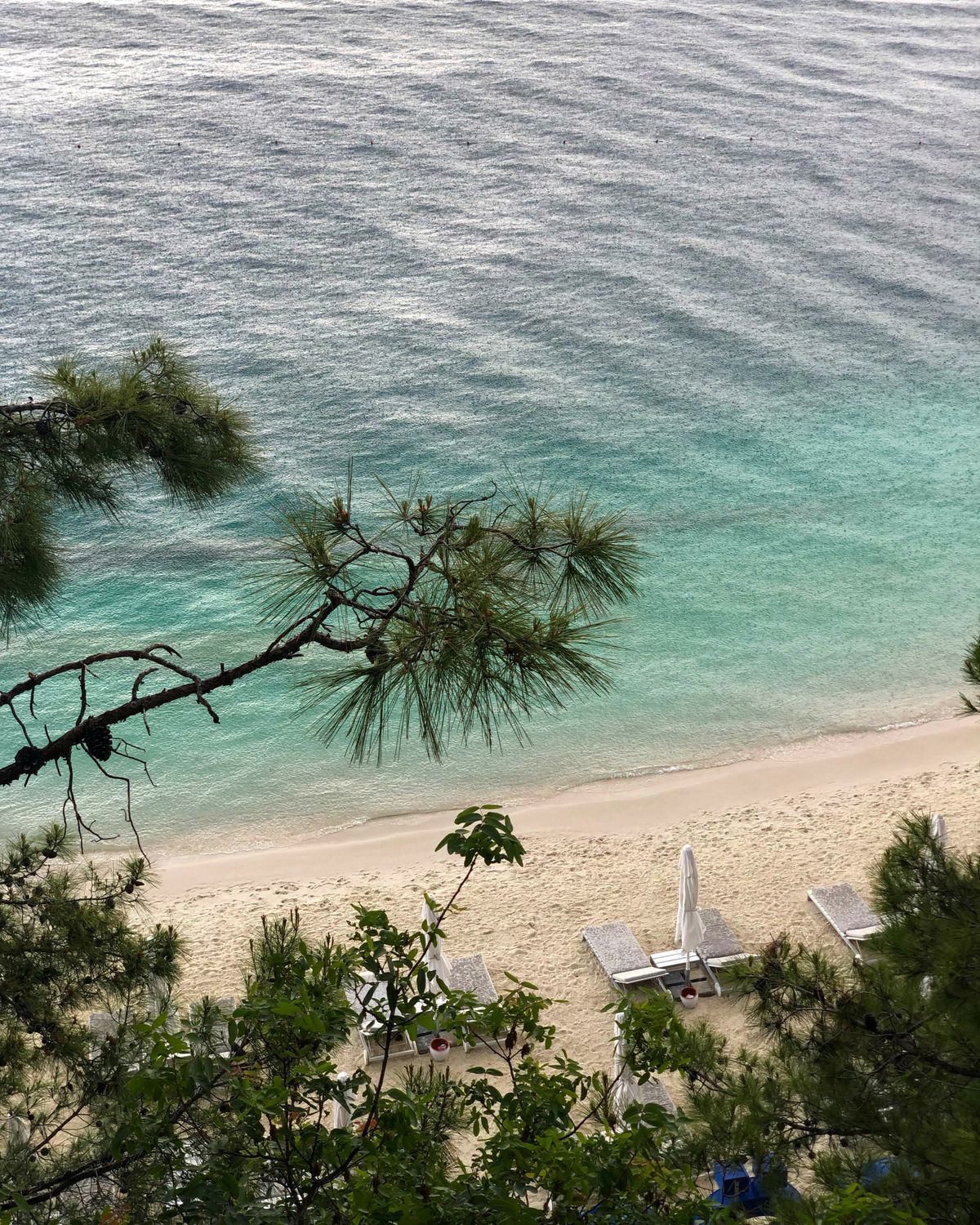
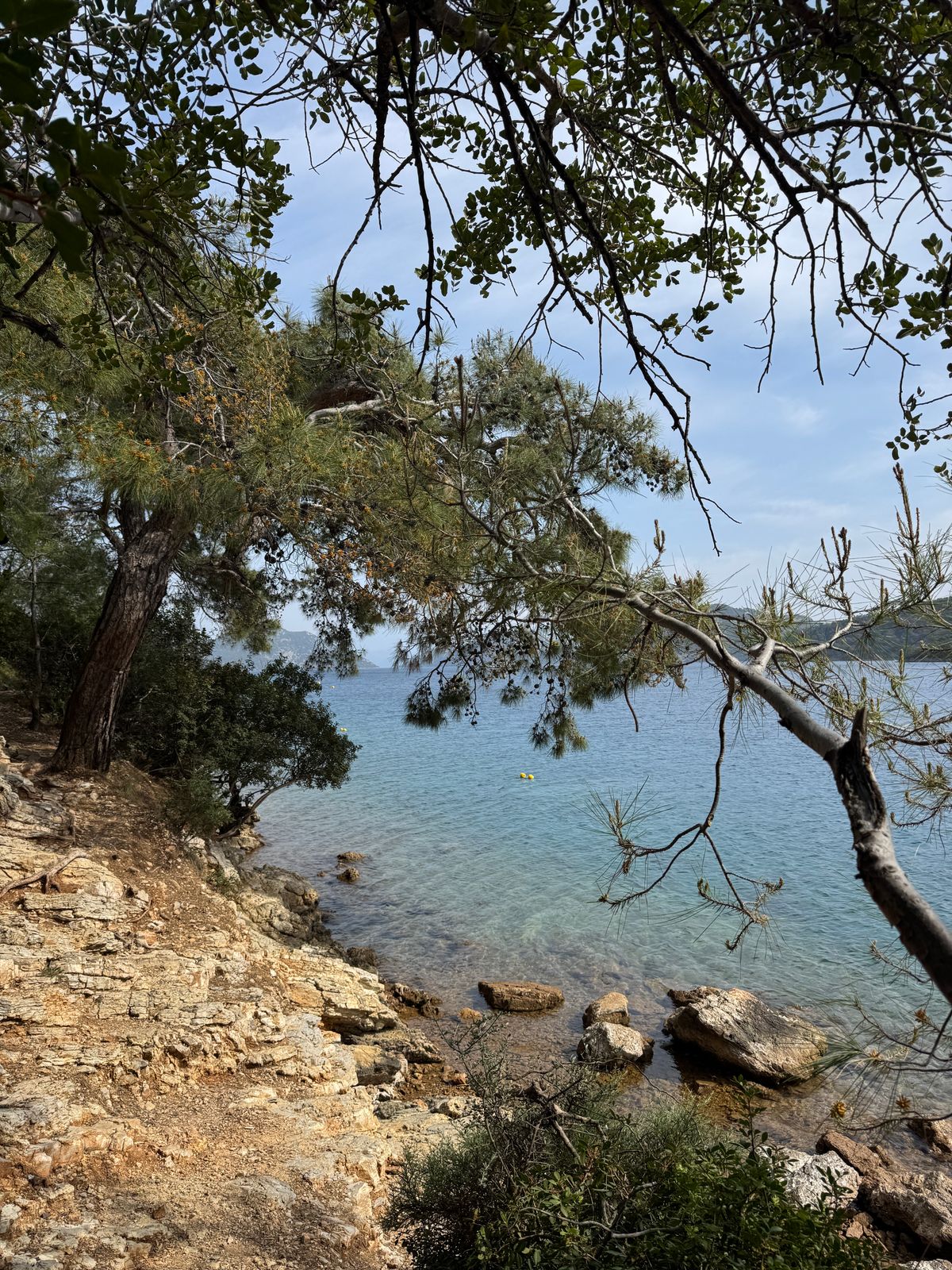
Most of the Muğla shoreline is shingle. Ölüdeniz is pebble, Çalış is a coarse grit that punishes bare feet, İçmeler is stones graded down to something tolerable. Sarıgerme is sand — roughly six kilometres of it, running east towards the mouth of the Dalaman Çayı, backed by low dunes and then by a wall of Turkish red pine that comes almost to the top of the beach.
That combination is unusual enough to be the resort's entire case for existing.
Water shelves out very gradually. A child can walk fifty metres and still be waist-deep, which is why families rebook and why anyone wanting a proper swim wades a while first. Sea temperature sits near 20°C in May, holds between 26 and 28 through August, and is still around 24 in October — the swimming outlasts the flight schedule by several weeks.
Sunbeds occupy each hotel frontage, with public stretches between and a longer undeveloped run towards the river mouth, where the pines close in and the crowd thins to almost nobody. Afternoons bring an onshore breeze that takes the edge off the heat and, on the wrong day, puts a chop on the water.
In the fortnight either side of mid-August the developed section is as busy as anywhere in this register, the sand is too hot to cross barefoot between noon and four, and winter storms occasionally leave the beach narrower than the brochure photographs imply.
The turtles, and the rules they bring
Loggerheads nest here. Sarıgerme is far less famous for it than İztuzu, half an hour west, and it does not sit inside the same protection regime, but the same species — Caretta caretta — hauls out on this sand between roughly May and August to lay, and hatchlings dig their way clear from July into October.
What follows from that is a short list of rules, expected of visitors and routinely ignored by them.
- Nothing sharp goes into the sand past the marked line — no umbrella spike, no windbreak pole.
- Beach furniture comes off the sand at dusk and does not return until morning.
- Staked and caged nests are not decoration and not a photo prop.
- Holes dug during the day get filled in before you leave. A hatchling that drops into one at night does not climb out.
- Light facing the sea disorients hatchlings, which head for the brightest horizon they can see. That includes a phone torch.
Do not come expecting an organised turtle experience. Nothing here resembles a guided night walk; this is a working holiday beach that a protected species also uses, and enforcement rests largely on hotel staff and on guests behaving. For what full protection looks like — beach closed at night, wardens, a boundary with teeth — see İztuzu.
Osmaniye, the village behind the pines
Walk inland from the hotel strip and the village turns up after a few hundred metres. One main street, supermarkets stacked with sun cream and factory-copy football shirts, a pharmacy, tailors promising a suit in forty-eight hours, leather shops, tattoo studios, and perhaps a dozen restaurants.
Food is decent and unambitious: gözleme cooked to order on a griddle, pide, mixed grills, the standard meze plates. Expect to pay less than in Ölüdeniz and more than in Ortaca, with quality that tracks the season more closely than the menu.
Osmaniye is not a Turkish village you stumble into by accident. It grew to serve the hotels and makes no secret of it — signage in English and German before Turkish, shopkeepers who can tell which flight you came in on. A golf course sits behind the strip, which says as much about the intended guest as anything could.
For a working town, Ortaca is eleven kilometres inland: banks, a hospital, a weekly street market, and dolmuş onward to Dalyan and Köyceğiz.
Sarıgerme is not a place you explore. It is a beach with accommodation attached, and any honest account of it has to begin there.
What is Baba Adası?
Offshore at the eastern end, a low wooded island sits a few hundred metres out — Baba Adası on the maps, Baba Island in the hotel leaflets. Uninhabited, scrubby, pine-topped, and the one thing on the horizon that isn't hotel or hillside.
Scattered masonry on it is generally associated with Pisilis, a minor ancient settlement on this coast. Nothing about the remains is monumental and no excavation runs there; the province's better-catalogued archaeology, indexed on the national culture portal, lies inland. Small boats cross in summer from the beach.
The swim looks shorter than it is. Open water is consistently misjudged from a beach, the channel carries current, and boat traffic uses it. Somebody tries it every season. Take the boat.
The evening problem
Almost everyone here is on an all-inclusive board, which means almost everyone eats in their hotel. Village restaurants survive on the fraction who don't, and the strain shows: energetic hosts working the pavement in July, half the shutters down by late October.
Nightlife amounts to a handful of bars with football on the screen and covers on the speakers. No clubs, no promenade worth the name, nothing approaching the volume of Marmaris — which is either the resort's failing or the precise reason to book it.
If eating somewhere other than your hotel more than twice in a week matters to you, budget for taxis. Dalyan is the obvious dinner run at about twenty-five kilometres, and the last dolmuş inland leaves long before the restaurants close. The local transport entry covers what runs and how early it stops.
Who this suits, and who it does not
- Families with children under about ten — few better options in the province. Shallow water, soft ground, short transfer.
- Anyone landing late — nothing is closer to the runway, and a tired child asleep in twenty-five minutes is worth a lot.
- People who want a town — go to Fethiye or Dalyan. This is not that, and a week will feel long.
- Travellers without a car who like moving — awkward. Every onward journey starts with a change at Ortaca.
- Ruins, gorges, walking — base further east, or hire a car and accept it sits idle half the week.
One week here rests people thoroughly. Two weeks tests them, unless the sunbed genuinely was the plan. The natural counterweight is Dalyan, a short drive inland, which supplies the mudbaths, the rock tombs and the walking that Sarıgerme has no intention of providing; regional orientation is published by the national tourist board.