İztuzu is not a beach that happens to have turtles on it. It is a nesting site people are allowed to use in daylight, and nearly everything odd about the place follows from that — no hotels behind it, a line beyond which no parasol may be planted, a warden clearing the sand at eight in the evening.
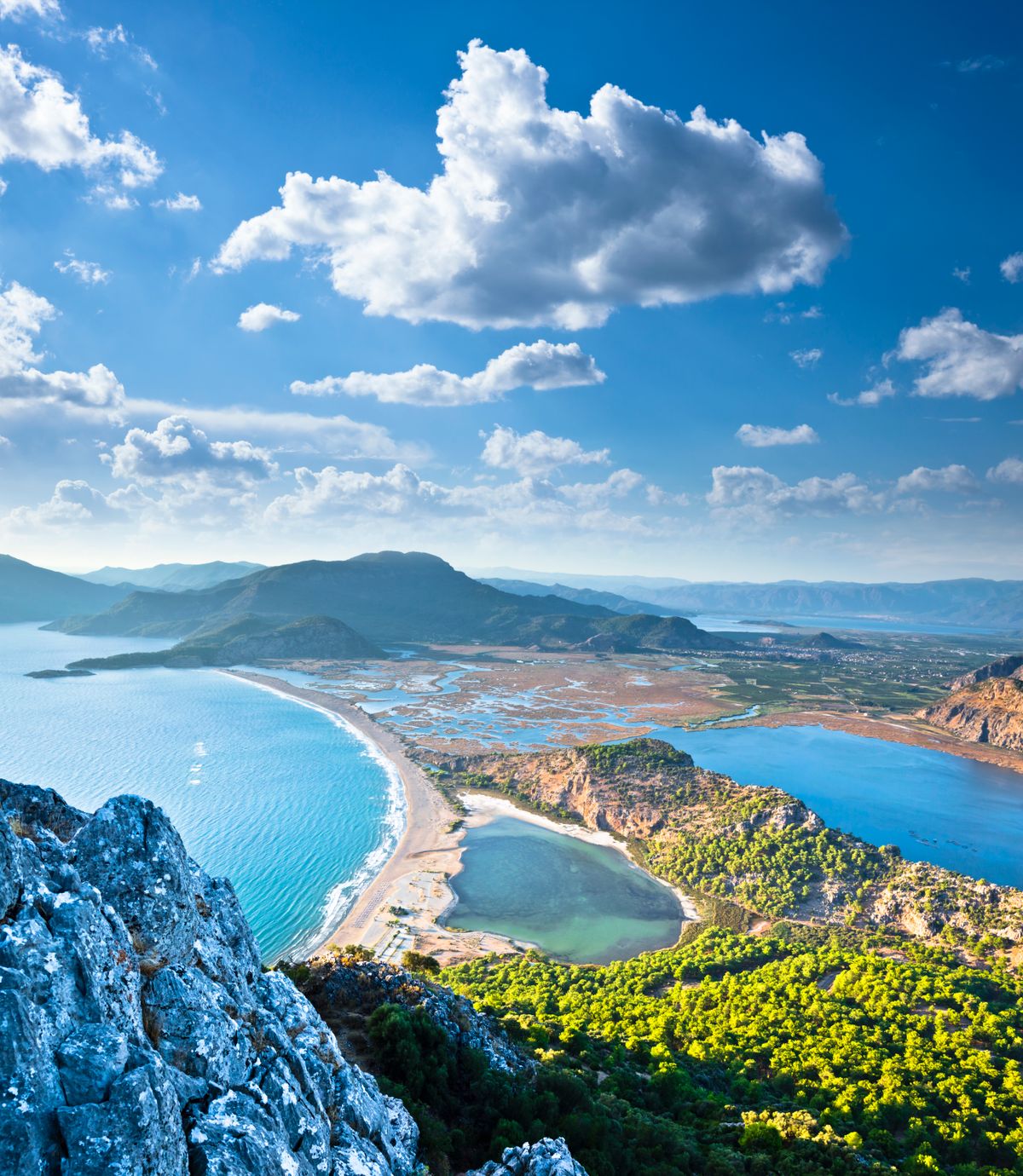
Four and a half kilometres of sand, give or take. Fresh water on one side, open Mediterranean on the other. Nothing built on it.
Visitors tend to arrive expecting a beach and leave having thought about turtles, which is roughly the intended effect.
A sandbar with a river behind it
Geography first, because it explains the rest. Water leaving Köyceğiz Lake runs south as the Dalyan Çayı, breaks into a delta of reed channels and brackish lagoons, and would empty straight into the sea if a bar of sand were not lying across its mouth. That bar is İztuzu — sea on one flank, river and marsh on the other, dune and scrub down the middle.
Reeds in the channels stand well above head height, which is why the boat trip in feels like a corridor rather than a view.
The name of the town upstream gives away what this delta has always been for. A dalyan is a fishing weir, and these channels have been worked with fixed traps for centuries — grey mullet mostly, the cured roe still sold in Dalyan and Köyceğiz.
Sand here is coarse, pale and steep. When an afternoon southerly gets up, the middle picks up real surf and a pull along the shore, with no lifeguard for most of its length. One other resident is worth knowing about: the Nile soft-shelled turtle, a large freshwater species down to a handful of Mediterranean rivers, holds on in the channels behind.
The hotel that was never built
By the middle of the 1980s the drawings were done. A hotel complex — reported at the time at something like 1,800 beds — was to go up behind the beach, permissions granted, site earmarked. On this coast that would have been ordinary; almost every comparable stretch of sand between Marmaris and Fethiye now carries a row of concrete.
What stopped it was an argument made loudly by very few people. June Haimoff, a British woman who had sailed into Dalyan and stayed, was living in a hut at the edge of the beach and objected to anyone who would listen. Botanist and broadcaster David Bellamy took the case up in Britain, and conservation bodies pushed the nesting data into the international press and the Bern Convention machinery.
In 1988 the Turkish government declared the Köyceğiz–Dalyan area a Specially Protected Area. The hotel died with the designation.
Nothing about the emptiness here is accidental. It is a decision taken against money, against the whole run of that decade, and then held for forty years.
Haimoff — Kaptan June to everyone in Dalyan — stayed for the rest of her life and died in 2022, a few months short of a hundred. Her hut has been restored and sits at the beach as a one-room museum. The record of that campaign is worth ten minutes before you go.
What the turtles actually do here
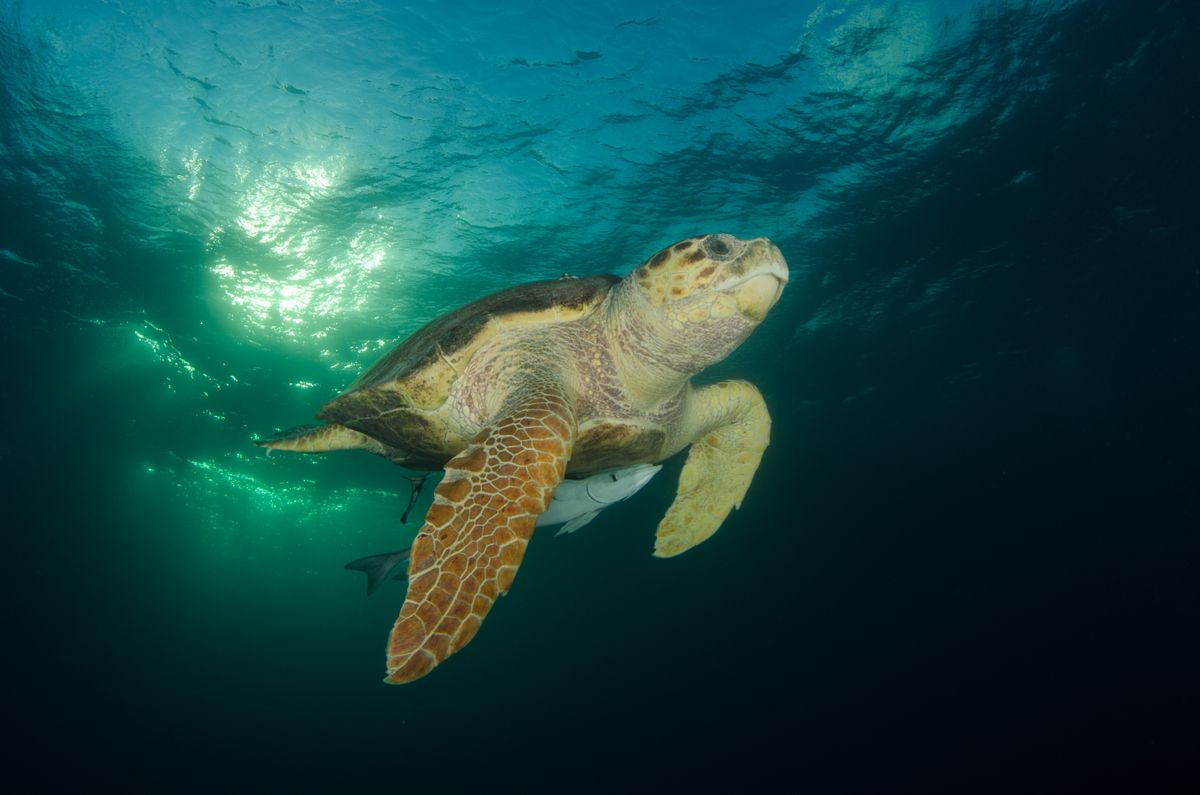
Loggerheads — Caretta caretta — nest on a scattering of beaches around the eastern Mediterranean, and İztuzu is among the more productive, running to a few hundred nests in a normal season.
Their pattern is fixed. From May into July, females haul out after dark, work up past the tide line into dry sand, dig a chamber with their back flippers, drop seventy to a hundred and twenty eggs and go back to the water. Incubation takes seven to nine weeks. Hatchlings surface at night from late July through October and make their own way down the slope.
Sand temperature decides the sex of a clutch, which is why the depth and position of each nest matters, and why a hotter decade is a problem this beach cannot solve for itself.
A survey team walks the whole length each morning in season, reading the previous night's tracks; confirmed nests get numbered stakes and, where foxes or loose dogs are a risk, a wire cage.
Set expectations honestly. Nesting happens after the beach has closed, deliberately, so no daytime visitor watches it. What you may see at the river end are adults loitering near the boat landing because people buy blue crab to throw at them — legal, popular, plainly bad for the animals, and not something this register would join in. The species is documented well enough without that.
Rules that are not decoration
Five constraints shape a day here, all of them enforced:
- The beach closes overnight — around 20:00 to 08:00 through the nesting months, roughly May to October. No evening swim, no exceptions.
- Sunbeds and umbrellas only in the marked strip near the water. Dry sand behind the poles is nesting ground and stays clear of furniture.
- No digging in the back sand, and no driving parasol spikes or tent pegs into it.
- No vehicles, no camping, no fires, no dogs.
- Nothing gets built. No hotel, no apartment block, no beach club, and there will not be one.
Enforcement is real and a little brusque. Staff begin clearing the sand before the hour and do not negotiate. Anyone used to being agreeably ignored elsewhere on this coast finds the change of tone startling — it is also why the arrangement still works.
The rescue centre
Near the river end stands DEKAMER, the sea turtle research, rescue and rehabilitation centre, set up in 2009 and run with a university veterinary faculty. It is a clinic rather than an attraction: tanks hold loggerheads recovering from propeller strikes, swallowed hooks and monofilament line.
Admission in season runs on a small donation, which funds a good part of the work. Twenty minutes is the right length of visit. Interpretation is thin, enclosures are built for treatment rather than display, and some injuries are hard to look at — an animal missing half a front flipper is not unusual.
Season summaries and case records go up on the centre's own site.
Boat or road?
Two ways in, producing completely different days.
| Route | Journey | Lands you at | Suits |
|---|---|---|---|
| River boat from the quay | 30–45 min each way | the river end | anyone who wants the delta as much as the beach |
| Dolmuş by road | about 13 km, 20–25 min | the far end, by the car park | early starts, short visits, going back for lunch |
| Own or hire car | about 13 km | the car park | flexible timing, cool boxes, small children |
Cooperative boats leave the quay in Dalyan through the morning on a fixed return fare, threading the reed channels below the rock-cut tombs in the cliff opposite town. Those belong to the Kaunos entry, though the water gives the better view of them, and the delta throws in herons, terrapins and the occasional kingfisher.
Then comes the catch. Boats stop running back in the late afternoon, the last departure is posted at the landing and does not wait, and a beach visit therefore becomes an eight-hour commitment whether you wanted one or not.
Road access is duller and far more efficient: thirteen kilometres around the hills from Dalyan, twenty-odd minutes, with a seasonal dolmuş that thins sharply once summer ends — local transport across the province follows the same logic everywhere. From the airport it is about 45 km, an hour or so by road.
Worth a whole day?
Shade is the weakness, and a serious one. Nothing grows on a sandbar. Hired umbrellas exist only inside the permitted strip and are gone by mid-morning in August, with nowhere to retreat to — no bar, no arcade, no pine grove behind. Along the middle three kilometres there is no water, no shelter and no shade at all. Carry more water than seems reasonable.
Facilities amount to a buffet, showers and toilets at each end. That is the price of the 1988 designation, worth paying, though it makes İztuzu a poor choice for anyone whose idea of a beach day involves a menu and a lounger with a back to it. Sarıgerme, half an hour west, does that job properly.
Season matters more here than at a beach with buildings behind it. Late May and June are the best of it: sea warm enough to swim, sand not yet punishing, nests going in nightly. September into early October is the other window — water still around 25°C, crowds gone. July and August bring hard light, burning sand and a boat queue at the Dalyan quay already ugly by ten. Out of season the bar is empty, windy, an excellent two-hour walk, and completely shut. The seasonal picture across the province is set out separately.
Reduced to a plan: come early, take the boat one way if you can stand the logistics, walk out into the middle where almost nobody bothers to go, and be off the sand by eight. Regional visitor information is published by the national tourist board.