Most people book this coast around school holidays and cheap seats, which is how they end up on a Muğla beach in the second week of August, paying the highest price of the year for the least pleasant version of the place.
Timing here is not complicated. Rain falls almost entirely between November and March; from mid-June to mid-September a wet afternoon is unusual enough to be remarked on. What varies is heat, price and how many people stand between you and the water. Two other calendars — turtle nesting on the sand, a flying season on the mountain — decide the rest.
The shape of the year here
Muğla is wetter than visitors expect. Something over 900 mm of rain lands on the Fethiye plain in an average year — more than London — and nearly all of it in one winter block. December is comfortably the wettest month; a single day of it can outdo July and August combined, which manage close to nothing.
Two wind names work as local shorthand. The meltem, a northerly, blows down the Aegean through high summer and is why afternoons in the Gulf of Gökova turn choppy while the bay at Fethiye stays glassy. Lodos, warm and southwesterly, belongs to winter and puts the gulet fleet on their moorings. Altitude counts too: Muğla town sits inland at around 650 m, runs several degrees cooler than the shore and takes snow some winters, so treat coastal figures as a ceiling, not an average.
Season by season, in one table
Figures below are typical, not guaranteed; each has been beaten in both directions.
| Period | Daytime air | Sea | State of things |
|---|---|---|---|
| March–April | 18–22°C | 17–18°C | Green hills, wildflowers, rain likely; resorts reopening |
| May | 25–27°C | 20–21°C | Warm, quiet, water sharp on entry |
| June | 30–32°C | 24–25°C | Hot but workable; sea warm; pre-rush |
| July | 33–35°C | 26–27°C | Very hot, very full, expensive |
| August | 34–37°C | 27–28°C | Hottest, fullest, dearest; humid nights |
| September | 30–32°C | 26–27°C | The strongest month of the year |
| October | 25–27°C | 23–24°C | Warm sea, thin crowds, first rain late |
| November–February | 15–20°C | 17–19°C | Wet; resort strips shut, towns carry on |
August is the worst deal on this coast
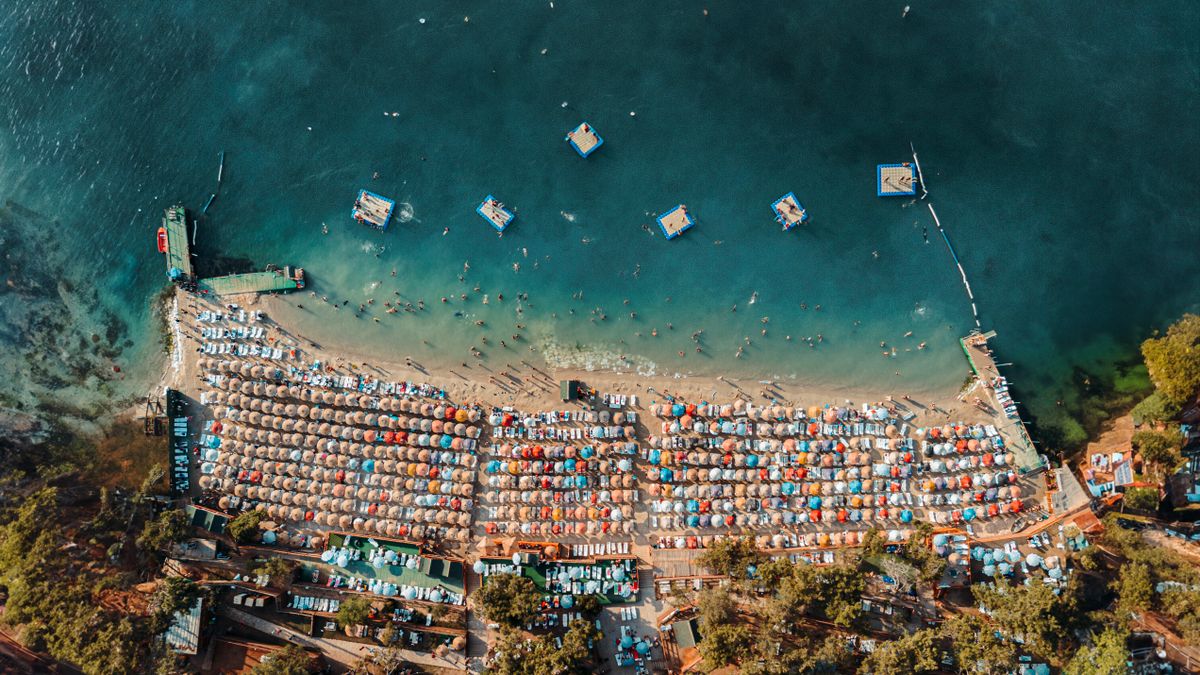
Nothing about August is good value. Shore temperatures sit in the mid-thirties and push higher inland; nights are humid rather than cool, which is what actually wears people down. Every flight is at peak fare, every hotel at peak rate, and the beaches absorb Turkish domestic holidaymakers at the same time as the northern European school break.
Effects are specific. Car parks at Ölüdeniz fill by mid-morning and the sunbed rows go before ten. The D400 crawls behind lorries and coaches. Kitchens run at capacity, which is rarely when they cook best.
There is also fire. Muğla province burned badly in the summer of 2021, and every dry August since has carried a real risk of smoke, closed forest roads and cancelled excursions. Not a reason to stay away permanently, but it belongs in the calculation.
Paying the highest price of the year for the hottest, most crowded fortnight is defensible only if school terms leave no alternative. Almost nobody chooses August freely twice.
Where the good months actually are
Two windows do the job properly: mid-May to the end of June, and all of September into the first fortnight of October.
September is the best single month here, and this register will keep saying so. Sea temperature lags air by roughly a month, so the water sits at or near its annual peak while the air has dropped back into the low thirties. Crowds thin sharply from the last week of August. Prices fall with them. Everything is still open.
June has a different appeal: sea warm enough to swim without ceremony, the longest days of the year, no school rush. Its drawback is that the hills have already dried to straw, so anyone hoping for green landscape has missed it.
- Swimming and eating — September, without much argument.
- Walking and ruins — late April, May and October, when inland heat is bearable.
- Empty sand, warm water — the first ten days of October.
- Value — May and October, at roughly half the August airfare.
Late October is where the balance tips. Rain returns, seafront kitchens close for the year, dolmuş frequencies drop. Booking the last week of that month is a gamble that pays out perhaps two years in three.
How warm is the sea, really?
Colder than the brochures imply in spring, and warmer than anyone expects in late autumn.
February and March are the low point, around 16–17°C — swimmable only by the committed. April creeps to 18. May reaches 20–21°C, which most people call bracing rather than pleasant. June settles at 24–25. By late August the open coast holds 27–28°C, and shallow enclosed water such as the Ölüdeniz lagoon runs warmer still.
Then comes the part that gets overlooked. October still gives 23–24°C, better than the Mediterranean average for that month, and November hovers near 21°C with almost nobody in it.
One exception runs the other way. Saklıkent gorge is fed by snowmelt off the Akdağ massif and stays painfully cold all summer; visitors fresh from a 28°C sea last about ninety seconds in it.
The fortnight the hills are green
Between roughly mid-March and early May the landscape is a different colour. Winter rain leaves the slopes genuinely green, and the ground cover comes with it — poppies in sheets along field edges, wild orchids on the limestone, anemones, and citrus blossom in the groves around Dalaman and Ortaca. Almond blossom runs earlier, in February.
By the end of May it is over. Grass goes to straw, the hills turn the pale gold they hold until November, and a July photograph bears little resemblance to an April one.
Spring is the walking season, and the inland sites — Lycian tombs, hill villages, the gorge approaches — are at their best when nobody is doing them in 35°C. Two caveats. Rain stays likely into April, sometimes for days. And meltwater keeps the gorge running high and its walkway occasionally shut until late spring, so an April visit can end at the entrance.
Two calendars that are not yours
From roughly 1 May to the end of September, İztuzu is a loggerhead nesting beach first and a public beach second. Caretta caretta come ashore at night to lay, and the rules are enforced rather than advisory: closed to people between 20:00 and 08:00, sunbeds confined to a marked strip well back from the water, no digging, nests caged and numbered where they lie. Hatchlings emerge from late July into October. Treat İztuzu in that window as a protected site that allows swimming, not a resort beach with signage.
A second calendar belongs to Babadağ above Ölüdeniz, whose take-off platforms sit between about 1,200 m and just under 1,970 m. Tandem paragliding runs from roughly April to early November; winter closes it with snow at the summit and cloud on the ridge.
Wind cancels flights far more often than visitors plan for. Most take-offs happen in the morning before the thermals build, and a strong meltem or low cloud on the ridge grounds everyone for the day. Book for the first half of a stay, not the last morning, so there are spare days in hand.
What is actually open in winter?
Less than the brochures suggest, and it deserves stating bluntly. A November-to-March package to Sarıgerme or Ölüdeniz will find most of the resort shuttered. Sarıgerme is a hotel strip attached to a beach, and out of season there is close to nothing behind it; the Ölüdeniz seafront shuts down much the same way.
Real towns behave differently. Fethiye has a permanent population and functions all year: the Tuesday market runs, the fish market works, harbour restaurants stay open, prices are what locals pay. Marmaris shrinks dramatically but does not close. Köyceğiz and Dalyan keep enough life for a quiet week.
Winter’s arguments are green hills, empty archaeological sites, snow on the inland peaks, low prices and daytime air that often reaches 15–18°C. Against that: heavy rain, short days, thinned dolmuş timetables and a coastline of closed shutters. It suits one kind of trip and ruins the more common one.
None of this argues against August if August is all you have. It argues against expecting the same coast. Long-run climate figures for the province are published by the Turkish State Meteorological Service, background on the nesting species by Britannica, and a seasonal regional overview sits with the national tourist board at GoTürkiye.